


Why Add a Plastic Recycling Granulator for In-House Scrap?
We talk to a lot of plastic product factories that ship their trim and edge scrap out at whatever price a scrap buyer will offer, and almost all of them eventually ask the same question: why are we paying to haul material away that could go straight back onto our own production line? A plastic recycling granulator is the answer that question usually leads to - a machine that turns factory edge waste into saleable, reusable pellets in one continuous run, right where the scrap is generated. For small and mid-sized recycling operations, it changes the economics of a waste stream from a cost line into a raw material.
Product Overview
A granulator takes waste plastic - factory offcuts, production rejects, clean film scraps, collected regrind - and processes it through melting, filtering, extrusion and cutting into uniform pellets that re-enter the production cycle. The machine is developed around long daily running hours, balancing steady output, sensible power use and stable performance rather than peak numbers on a spec sheet. That matters because a granulator in a small plant runs every shift, not as a showcase piece; what counts is that it holds the same pellet quality at hour eight as at hour one.
The build is tuned to real granulation conditions. Screw and barrel are matched to each other, transmission and heating components stay stable through long runs, and the result is even melting and smooth extrusion without the surging that ruins pellet consistency. Material flexibility is broad - by adjusting temperature, screw speed and internal settings, one machine handles PP, PE, ABS, PS, HDPE, LDPE, industrial offcuts and mixed regrind without structural modifications, so a plant that switches recipes is not stuck rebuying equipment.
Applications
Where a granulator earns its keep is wider than dedicated recyclers might expect.
- In-house production scrap recycling. The strongest case. Edge trim, runner scrap and startup-off material from your own lines go straight back through the granulator instead of to the scrap buyer - recovered at pellet quality, fed back into the same process.
- Plastic product manufacturing plants. Factories running extrusion, thermoforming or injection lines recover their own waste stream and reduce virgin resin purchase at the same time.
- Professional recycling enterprises. Smaller dedicated recyclers buy in mixed clean waste and run it to consistent, saleable pellets without a plant-sized investment.
- Pellet processing and distribution centers. Operators buying in regrind, standardizing it into uniform pellets, and selling on as a known, consistent feedstock.
Every core wearing part - reducer, screw, barrel, bearing - is built for high-load non-stop operation, and the modular layout makes cleaning, residue removal and parts replacement straightforward for the crew that runs it every day. A control panel with clear parameter logic and basic fault prompts keeps daily work simple, and optional waste-gas treatment and noise-reduction parts can be added to meet local environmental standards.
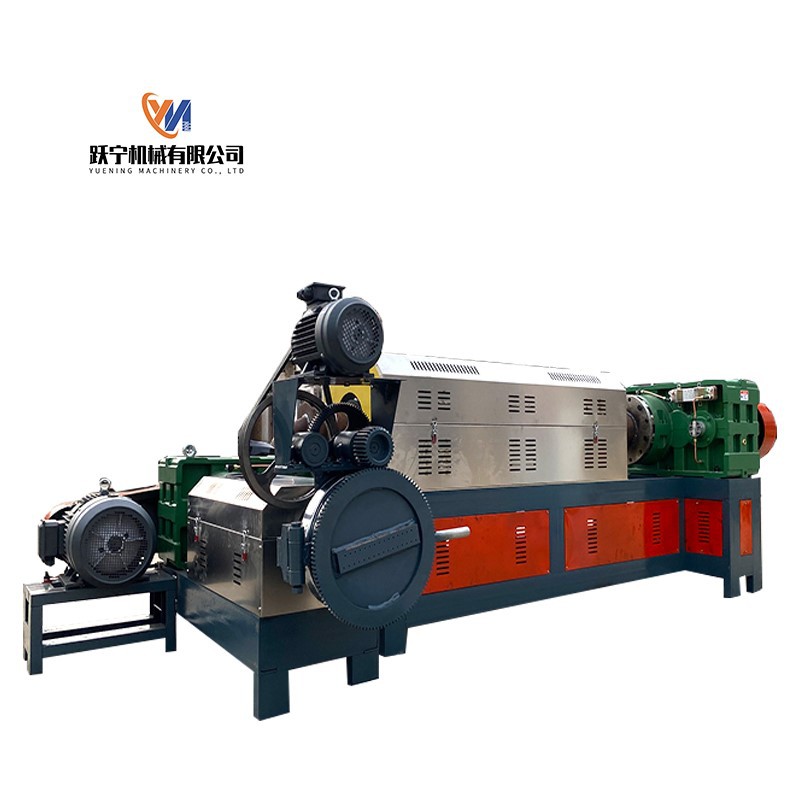
The shift most factories make is quiet but lasting: the scrap buyer's invoice stops arriving, virgin resin orders drop, and the material that used to leave the yard in a bale comes back in a pellet bag through your own line. Whether you run a product plant recovering its own trim or a small recycling operation buying in clean waste, the plastic recycling line closes the loop in one continuous process. The point is not that granulators are glamorous equipment; it is that once the edge waste turns into feedstock you control, the waste stream stops being something you pay to remove.


